A student opens an artificial intelligence tool to study. A worker wants to organize documents. A small business owner needs to make sense of a week’s sales. The technology may help in each case, provided someone knows how to ask a useful question, spot an error and check the answer.
The challenge can begin before the screen. Access to computers, reliable Internet connections and the skills to evaluate these tools are unevenly distributed.
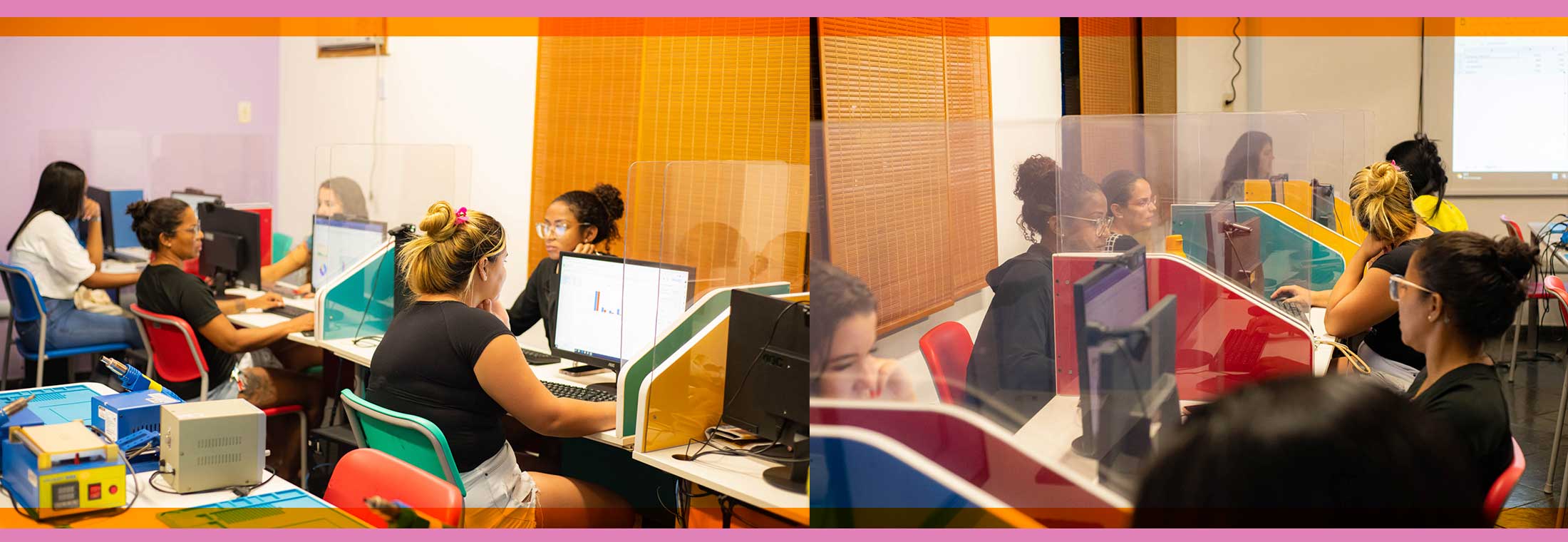
In Maré, a large complex of favelas in Rio de Janeiro, projects such as Conectando and Nas Ondas da Maré offer concrete experience in technology education. Brazilian and international organizations have also worked on digital safety, connectivity, community data and learning. Their work points to a practical question: how can favela residents gain the skills to use AI independently and participate in the opportunities emerging from the digital economy?
Who is already using AI in Brazil?
Brazil’s ICT Households 2025 survey found that approximately 50 million people, or 32% of Internet users aged 10 and over, had used generative AI.
The share reached 69% among Class A Internet users but just 16% among those in Classes D and E. That 53-percentage-point difference reveals a sharp socioeconomic divide. Education matters as well: 59% of Internet users with higher education reported using generative AI, versus 17% among those with primary education.
These are nationwide figures. A local survey in Maré could provide more precise evidence on how frequently residents use AI, what they understand about it and which obstacles they face. The Cetic.br findings offer a useful starting point.
 AI LITERACY
01 / 04
THE AI REVOLUTION IS UNEVEN.
Internet users who reported using generative AI in Brazil, by social class, 2025.
| Group | Share using AI | % |
|---|---|---|
| Class A | 69% | |
| Brazil average | 32% | |
| Classes D/E | 16% |
53PERCENTAGE POINTS between Class A and Classes D/E
What are local technology projects already teaching?
Launched in 2017, Conectando reports training approximately 1,300 people. Its programs cover computer skills, spreadsheets, online safety, web programming and workshops on artificial intelligence, misinformation and the labor market.
According to the Redes da Maré 2025 annual report, Nas Ondas da Maré trained 173 students in technology that year and achieved a 70% completion rate. From 2022 through 2025, 11 students entered technology-sector employment. The program also creates opportunities for former students to return as educators.
Another initiative is data_labe, a community-rooted data and storytelling organization founded in Maré. Its work combines research, journalism and training to make data more accessible and help residents document the conditions of their own neighborhoods.
Such experiences offer a foundation for AI courses that bring together experimentation, fact-checking and practical needs.
AI LITERACY02 / 04
TECH TALENT IS GROWING IN MARÉ.
course completion rate in 2025
students entering technology jobs from 2022 to 2025
Which Brazilian organizations are building AI and digital skills in Maré?
Redes da Maré provides computer, programming and introductory AI workshops. Its Conectando Mulheres program focuses on women, offering digital safety, programming and thematic AI activities.
data_labe, founded in Maré, organized the free Descomplicando IA: How to Democratize Artificial Intelligence in Favelas course in 2024. Supported by the Pulitzer Center and developed with Redes da Maré and the Federal University of Rio de Janeiro, the four-session program addressed AI fundamentals, risks, regulation, journalism and surveillance. The organization also published an AI literacy guide focused on critical use.
The Observatório de Favelas announced the return of its School of Popular and Critical Communication (ESPOCC) in 2026. Its audiovisual and technology tracks include AI, digital culture and community-generated data. The announced 200-hour course takes place in Maré. Its Bira Carvalho program offers another example: participatory digital mapping of accessibility barriers in the neighborhood.
Uniperiferias, based in Maré and connected to the Maria and João Aleixo Institute, manages Navezinhas Cariocas units in Maré, Rocinha and Rio das Pedras. The initiative provides free Internet access and courses in fields including AI, digital literacy, games and audiovisual production.
Fight for Peace (Luta pela Paz) documented its Campinho Digital web-development training in Maré in 2021 and later worked with UNICEF on Zona Nossa, a connectivity and civic learning initiative for young people in Maré and Pavuna. According to United Nations Brazil, approximately 350 participants received mobile devices and data access.
Together, these initiatives illustrate how community-led technology education can connect skills, rights, local knowledge and practical outcomes.
How are international organizations engaging with technology in Rio’s favelas?
Several documented initiatives provide lessons about funding, training and community participation.
The Orphaned Starfish Foundation has supported digital education programs run by Redes da Maré since 2017, including Conectando and activities for women. In May 2026, young people from Conectando and Nas Ondas da Maré took part in a foundation event in Rio de Janeiro.
The UK-based ICT4D Collective documented a September 2024 workshop at Casa Resistências in Maré. Local collaborators helped develop Portuguese-language resources covering safer, wiser and more private use of digital technologies. This experience offers a useful approach to privacy and digital security within AI education.
In June 2022, UNICEF, working with Fight for Peace, announced a program engaging 350 adolescents and young people in Maré and Pavuna. The Zona Nossa initiative combined connectivity, technology, civic participation, education and employment opportunities.
The international human rights organization WITNESS developed MobilizaJá, an experiment using livestreams to connect community activists with supporters. Its pilot focused on Rio’s Maré and Complexo do Alemão favelas. Although its aims differ from AI training, the project illustrates how residents can apply digital technologies to communication, local needs and rights.
In 2022, Internews published a case study of data_labe’s CocôZap, a WhatsApp-based initiative collecting reports from residents about sanitation in Maré. It demonstrates how technology can help communities produce information that is relevant to public decisions.
These initiatives differ in their goals, scope and dates. Each offers a documented example of technology being adapted to specific community needs.
What happens when a mobile data plan runs out?
The same national survey found that 39% of people who owned a mobile phone, around 64 million Brazilians, had exhausted their mobile data allowance at least once during the previous three months.
A training session can work well in a computer lab and become impossible to repeat at home. Devices, affordable access, mobile-friendly tools and low-connectivity options therefore matter as much as the classroom content.
Conectando faced this challenge during the pandemic. When staff learned that many students relied on phones rather than computers, they developed teaching materials adapted to mobile access.
 AI LITERACY
03 / 04
NO DATA. NO CONNECTION.
Connectivity costs can interrupt access to digital learning.
people in Brazil ran out of mobile data at least once over a three-month period.
HOW DO YOU LEARN AI WHEN THE CONNECTION ENDS BEFORE CLASS?
How can communities turn access into AI literacy?
UNESCO’s AI Competency Framework for Students connects technical understanding with ethics, applications and the ability to create.
In community education, a practical learning path can include six stages: understand, verify, apply, create, share and evaluate. The activities can be tailored to students, teachers, workers, local merchants, cultural producers and community groups.
Students might compare explanations and verify sources. Small business owners might organize sales records while checking figures against original documents. Cultural organizations might explore captioning or accessibility tools. Each use case creates opportunities to learn how to judge AI-generated results.
AI LITERACY04 / 04
FROM LEARNING TO INDEPENDENCE.
Six stages to develop AI skills through real community needs.
- 01
Understand
Capabilities and limits
- 02
Verify
Sources, mistakes and risks
- 03
Apply
Study and work tasks
- 04
Create
Local projects
- 05
Share
Community educators
- 06
Evaluate
Measured outcomes
What should an AI literacy program measure?
Enrollment alone cannot show whether a program changes how people use technology. Useful indicators include whether participants can repeat tasks independently, identify mistakes, protect personal information and apply what they have learned after training.
A territorial study could examine access, initial skills, practical applications and continued use. Follow-ups after 30 and 90 days could help identify changes in learning, productivity and possible work opportunities.
It would also be valuable to understand which obstacles remain, what solutions are developed locally and how much of the economic value created through digital tools can remain within the community.
The experiences documented in Maré and elsewhere in Rio show that community organizations can contribute to a broader model of digital education. Bringing AI into that work offers a way to connect technical skills, rights and livelihoods.
As artificial intelligence begins to influence everyday decisions, the ability to use it, test it and question it becomes part of meaningful participation in the digital economy.