
A mine in Brazil, a US-dollar supply agreement and four price floors that carry implications far beyond the mining site. The first commercial shipments from Serra Verde bring the Brazilian deposit into a strategic American procurement structure for rare-earth materials used in advanced permanent magnets.
On November 9, 2026, USA Rare Earth said its wholly owned Serra Verde operation in Minaçu, Goiás, had begun commercial-scale shipments of mixed rare earth carbonate (MREC) in October. First sales and payments followed in November. The purchaser is US SIIE, LLC, a purchasing vehicle funded by the US government.
For businesses assessing the deal, the crucial distinction is between mineral processing already carried out in Brazil and the additional separation, metallization and magnet manufacturing that can take place farther down the chain.
What minimum prices does the US-backed agreement set?
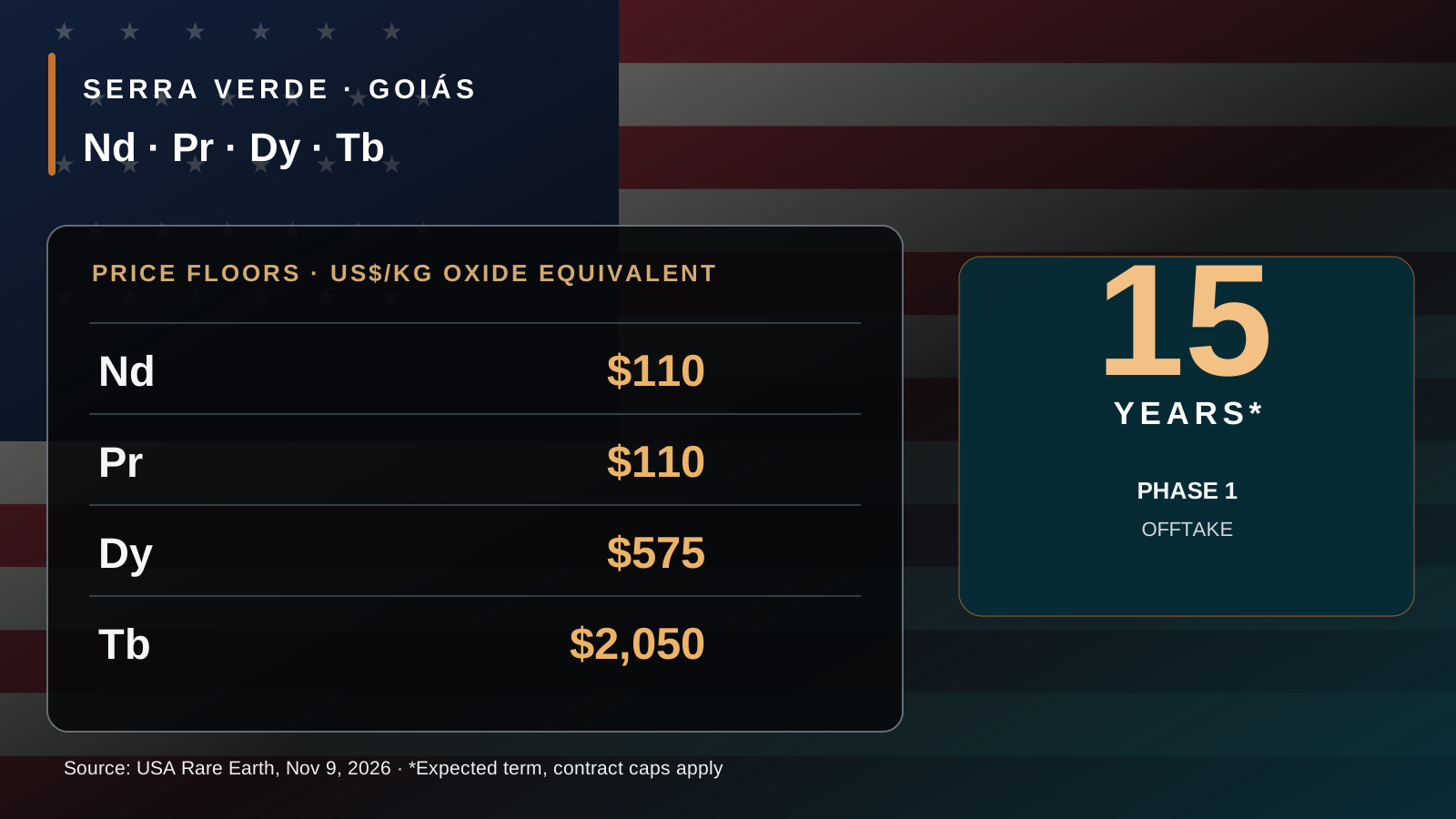
The agreement contains price floors per kilogram of oxide equivalent for four elements used in neodymium-iron-boron permanent magnets.
| Element | Symbol | Contractual floor |
|---|---|---|
| Neodymium | Nd | US$110/kg |
| Praseodymium | Pr | US$110/kg |
| Dysprosium | Dy | US$575/kg |
| Terbium | Tb | US$2,050/kg |
The supplier also receives 70% of the positive difference between specified non-China market indices and the respective price floors, under the agreement’s pricing methodology. Reference prices are drawn from European and US markets. Separated rare-earth products could also unlock revenue from other elements, including yttrium.
Each MREC shipment contains a mixture of elements in varying proportions. According to the company’s SEC filing, payments reflect the quantity of payable elements expressed as oxide equivalents, fixed recovery yields and contractual separation costs.
What does the expected 15-year term cover?
The agreement was entered into in April 2026 and covers 100% of products from Phase 1, with exceptions for testing, certain non-payable materials and other specified conditions. It is structured on a take-or-pay basis, assigning delivery or payment obligations under the agreed terms.
USA Rare Earth expects the contract to operate for approximately 15 years. Its legal termination is tied to the earlier of products derived from 198 million metric tons of run-of-mine ore or 20 years after the commercial operations date.
USA Rare Earth completed the acquisition of the holding company controlling Serra Verde on September 3, 2026. This gives the American company ownership of the Brazilian mine and processing facilities. The ownership transaction and the product offtake arrangement are distinct parts of the commercial structure.
What does the company say the Brazilian production is worth?
On November 9, USA Rare Earth reported the following fourth-quarter-to-date average total rare-earth oxide equivalent (TREO) basket values, net of contractual separation costs:
| TREO basket benchmark | Average value |
|---|---|
| Using contractual price floors | Approximately US$43/kg |
| Using market-index terms and the supplier’s upside share | Approximately US$97/kg |
These values cover a brief period of initial sales and are not guaranteed prices for the entire expected term.
The company targets a production run rate of 4,000 metric tons of TREO per year by the second quarter of 2027, rising to 6,400 tons by year-end 2027. They are forward-looking targets rather than already delivered volumes.
How much additional industrial value could Brazil produce?
Serra Verde already processes its mined material in Goiás into MREC. Exporting this mixed carbonate differs from exporting unprocessed ore. It also differs from producing individual separated oxides, metals, alloys or finished magnets.
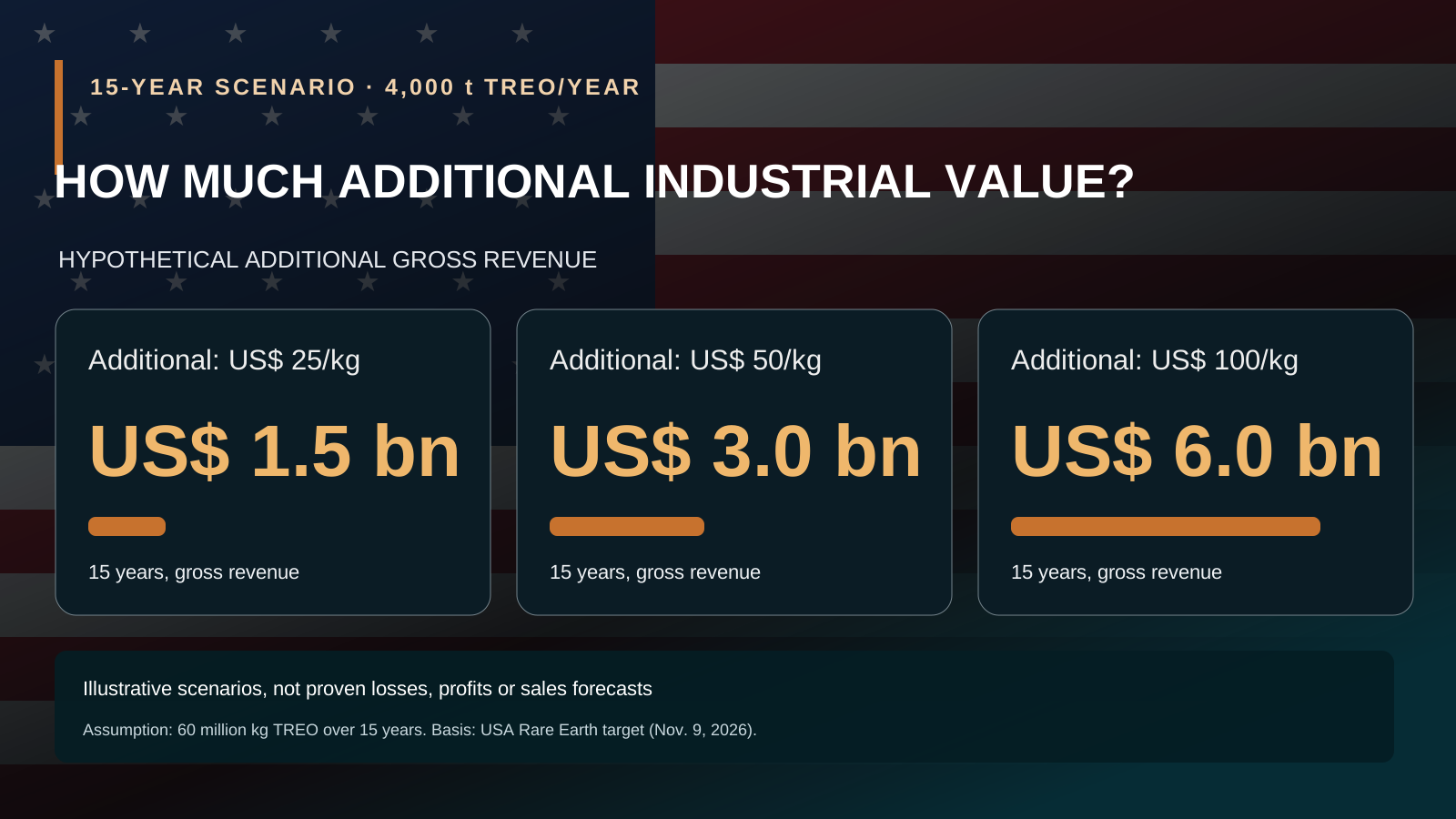
To illustrate the potential scale, NEODY calculated a sensitivity scenario: assume 4,000 metric tons of TREO annually for 15 years, equivalent to 60 million kilograms. The scenario holds production constant to compare three levels of additional industrial revenue.
| Hypothetical additional industrial revenue | 15-year amount |
|---|---|
| US$25 per kg of TREO | US$1.5 billion |
| US$50 per kg of TREO | US$3 billion |
| US$100 per kg of TREO | US$6 billion |
The figures represent hypothetical additional gross industrial revenue. Actual net economic gains would depend on industrial capital expenditure, operating costs, recovery yields, magnet prices, financing terms, customers and production schedules for facilities operating in Brazil.
The figures clarify the business decision. Processing rare earths into separate oxides, metals and finished magnets involves different technical capabilities, investment risks and commercial margins. Those stages determine where additional value can be captured.
Did the Trump administration seek priority access to Brazilian critical minerals?
Reports published on September 17, 2026 described a US trade proposal submitted on October 16, 2025. According to CNN Brasil and other coverage, the proposal included preferential purchase rights related to Brazilian critical-mineral deposits and assets. Brazil’s government said the demands had been rejected and would not be negotiated.
The 2025 diplomatic proposal addressed preferential rights to mineral assets. Serra Verde’s commercial agreement covers product supply by a company under American ownership. Together, they reflect US strategic interest in securing rare-earth supply chains.
What has Brazil done to encourage domestic processing?
Brazil enacted Law No. 15,506 on September 16, 2026, establishing a national critical and strategic minerals policy. On November 11, at COP31, the Ministry of Development, Industry, Trade and Services reiterated its ambition to move into higher-value industrial activities on Brazilian soil.
The policy framework exists. Whether Brazil gains manufacturing capacity will depend on individual plants, financing, process technology, contract structures and customers. Foreign participation does not by itself rule out domestic industrial investment.
Serra Verde is already producing and selling material. The remaining industrial question is where the next processing and magnet factories will be built, and who will capture the margins they create.
Related NEODY reporting: Brazil’s industrialization strategy at COP31 and Why Brazil has rare earths but produces so little.
Sources and visual credits
Reporting draws on USA Rare Earth’s original November 9 disclosure, the company’s Form 10-Q filed with the SEC, its third-quarter 2026 results, the Brazilian ministry’s COP31 statement published by Agência Gov, the official text of Law No. 15,506, CNN Brasil reporting on the October 2025 US proposal and Rádio Itatiaia’s interview with President Lula.
The US flag infographics were created by NEODY using the cited contractual terms and the economic assumptions presented in this report.