
On Friday the 13th, it seemed the witches were out in force.
Microsoft had been struggling with a global outage for more than 24 hours. In the United States, a telecommunications failure brought departures across the country to a halt. Meanwhile, Claude, Anthropic’s artificial intelligence assistant, was experiencing authentication problems, errors and degraded performance.
And that is before we get to Jensen Huang, Nvidia’s founder, and the extraordinary allegations involving a suspected Chinese spy. Over eight trading sessions, the company that supplies much of the computing infrastructure behind the AI boom reportedly lost $1.081 trillion in market capitalization.
What a week.
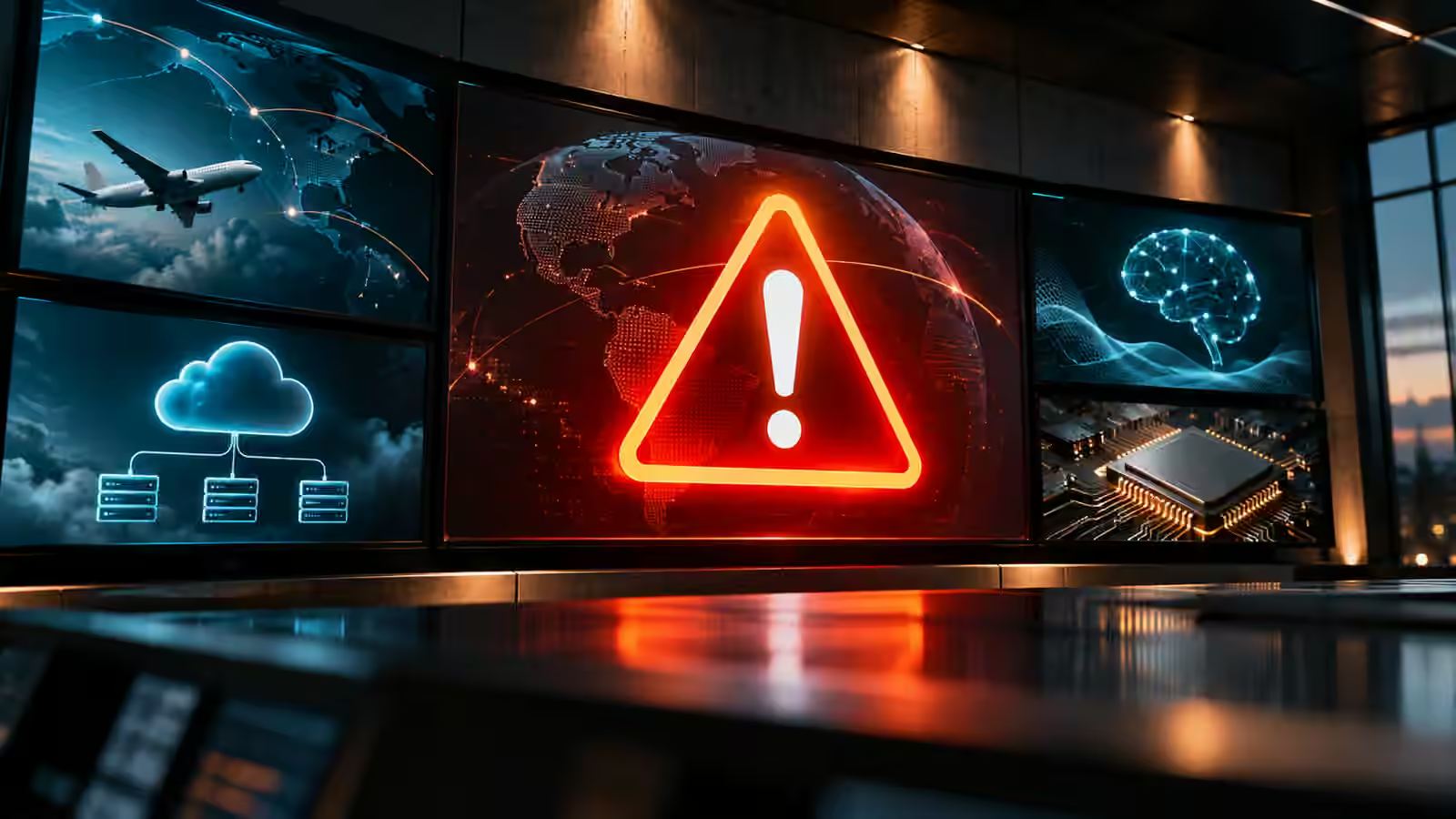
The plot could have come straight out of an apocalyptic thriller, enough to put everyone on alert, from the most skeptical observer to the most enthusiastic conspiracy theorist.
Coincidence or cyberattack?
There is no public evidence establishing that these events had a common cause. Some failures have technical explanations, other inquiries remain open, and at least one operational connection between Microsoft and certain Claude integrations has already been documented.
Artificial intelligence in US air traffic control
Three days before the nationwide halt, the FAA’s SMART project, which uses artificial intelligence, was deployed across 22 US air traffic control centers.
SMART brings together information from approximately 200 sources, including weather conditions, flight routes, aircraft traffic and staffing. Specialists analyze the data and develop scheduling recommendations that are subject to human review before any operational decision.
Coincidentally, just three days later, on Friday, November 13, a telecommunications failure interrupted departures across the United States. The Federal Aviation Administration ordered a nationwide ground stop as a precaution while technicians investigated the problem. Aircraft already airborne continued through arrival procedures.
The proximity between the SMART expansion and the disruption raises legitimate questions. The deployment, however, has not been identified as the cause. The dates alone do not establish technical responsibility.
Thousands of flights were delayed or canceled. After more than four hours, the FAA lifted the ground stop, although disruptions to flight schedules continued.
Homeland Security Secretary Markwayne Mullin said there was no indication of malicious interference and sought to reassure passengers and families. The full technical cause remained under investigation at the time.
In an interview with GloboNews’s J10 program, risk-management specialist Gustavo Cunha Mello emphasized that a risk manager should not rule out the possibility of a hacker attack before the underlying cause of an incident has been sufficiently established.
Microsoft: an outage that crossed industries and borders
Microsoft’s problems began on Thursday, November 12, and carried over into Friday the 13th. Outlook, Teams, Copilot and other Microsoft 365 services experienced disruptions in multiple countries.
In Brazil, the outage affected the justice system and prompted measures involving court deadlines. In financial markets, some traders fell back on phone calls and even fax machines to maintain essential communications.
Microsoft attributed the disruption to changes affecting its network infrastructure and server capacity, followed by a gradual restoration of service. The company said it had found no indication of malicious activity.
An email failure might sound minor until authentication, calendars, enterprise messaging and dependent workflows all begin to falter. The incident demonstrated how shared infrastructure can become a common point of failure for organizations that otherwise have little in common.
NEODY examined the effects on markets and courts in its original Portuguese report on the global Microsoft outage and the return of the fax machine.
Anthropic: Claude was also disrupted
On the same Friday, Anthropic recorded incidents affecting Claude, its website, authentication, the API and Claude Code at different times.
The company’s official status history documented two general incidents on November 13, both subsequently resolved. Problems with Microsoft 365 connections and Claude for Outlook had another identified source: the Microsoft services outage.
Anthropic confirmed that this dependency affected email, calendar and search functions. That establishes a connection between specific products, but it does not mean every problem Claude experienced had the same cause.
An incident at one technology provider can quickly become an operational problem for another. Any organization connecting multiple platforms needs to account for those downstream effects in its continuity plans.
Nvidia: espionage allegations, Jensen Huang’s departure and a $1.081 trillion loss
As if the week’s technological failures were not enough, Nvidia was facing a crisis that sounded like an international espionage screenplay.
At the center was Jensen Huang, Nvidia’s founder and one of the most influential executives in the semiconductor industry.
International reporting disclosed a relationship with Alice Huang, a businesswoman suspected by US authorities of acting on behalf of Chinese intelligence. Beijing has rejected the allegations. Suspicions and allegations do not amount to established findings of espionage.
Nvidia opened an independent investigation. The company said it had no reason to believe its trade secrets or US national security had been compromised.
According to an Elos Ayta market assessment reported by InfoMoney, Nvidia lost $1.081 trillion in market value between October 29 and November 10, 2026, a decline of approximately 21% over eight trading sessions. That total reflects share-price movements across the period and cannot be attributed in full to the espionage controversy.
In a filing with the US Securities and Exchange Commission, Nvidia confirmed Huang’s departure as president, chief executive and board member, effective November 11. Chief Financial Officer Colette Kress took over as interim CEO.
The episode brought national security, governance, investor confidence and semiconductor export controls into the same debate.
For additional context, see NEODY’s Portuguese analysis of the Jensen Huang case and the US-China chip rivalry.
Risk management: investigate thoroughly without spreading panic
When essential systems fail at the same time, public authorities and companies have a particular responsibility: investigate the causes, restore services and communicate accurately without fueling unnecessary alarm.
Sound incident management means keeping technically plausible hypotheses open while collecting evidence. That does not require treating every hypothesis as an established fact.
The National Institute of Standards and Technology (NIST) connects incident detection, analysis, containment, recovery and lessons learned with an organization’s broader risk-management program. The Centers for Disease Control and Prevention (CDC) recommends that crisis communication be timely, accurate, credible, empathetic and practical.
An authority’s statement that investigators have found no sign of a cyberattack provides important information about what has been established at that point. If the investigation is continuing, that uncertainty should also be communicated.
Equally, the possibility of an attack does not become a fact merely because several systems stopped working on the same day. Simultaneous failures are not, by themselves, evidence of a coordinated operation.
Can we keep operating when critical systems go down?
Digital services, cloud computing and artificial intelligence have delivered major productivity gains. They have also made companies and governments increasingly reliant on infrastructure controlled by a relatively small number of providers.
A company might have perfectly functional internal servers and still be unable to serve customers after losing its authentication service, email platform or a critical integration.
In aviation, telecommunications failures can require immediate precautionary measures even when investigators have found no evidence of criminal interference.
Effective risk management starts by identifying processes that cannot stop, testing alternative channels, reviewing supplier concentration and preserving safe fallback procedures.
In critical systems, the introduction of AI tools must also preserve human oversight, technical evaluation, isolation mechanisms and recovery options.
Microsoft offered an initial technical explanation for its outage. Anthropic recorded incidents of its own and disruptions inherited from Microsoft services. The FAA investigated the telecommunications failure. Nvidia, meanwhile, faced a separate corporate investigation involving espionage allegations.
No confirmed finding connects all these events to a coordinated attack.
Still, after a week like this, even people who usually dismiss conspiracy theories may find themselves paying closer attention.
If systems on which millions depend can fail in rapid succession, are we truly prepared to keep operating when they stop?