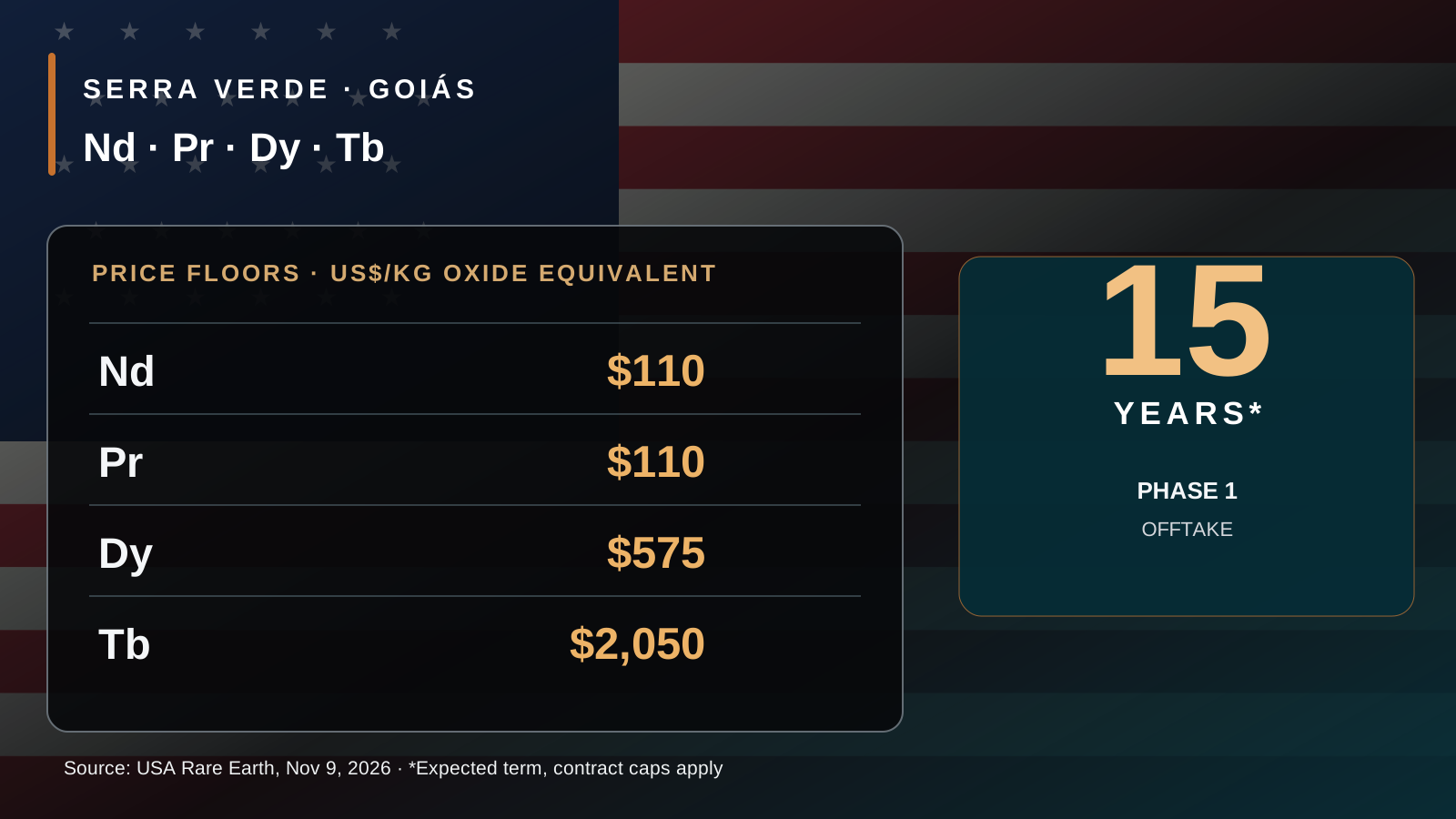


Neodymium is a useful starting point for understanding why a stretch of the Bahia coastline has attracted an international critical-minerals company. This rare-earth element is used in magnets that help electric motors and other equipment deliver high performance in a compact form, as documented in the US Department of Energy’s supply-chain assessment.
Energy Fuels intends to source some of the raw material in Brazil. In its May 2026 results announcement, the company estimated that its Bahia Project could eventually supply 3,000 to 5,000 metric tons of monazite per year to its White Mesa operation in Utah, United States. That is a long-term commercial projection, not an established production rate.
The project has also prompted questions about whether the substances stated in mining-rights applications match the commodities highlighted in corporate announcements, along with concerns about potential impacts on the region. These issues were described by the Brazilian newspaper O Globo on October 10, 2026. Assessing them requires the underlying records, environmental studies and decisions by the competent authorities.
Why neodymium matters to technology
Neodymium is one of the 17 rare-earth elements. Despite their name, these elements are not necessarily scarce in the Earth’s crust. The challenge lies in finding commercially viable concentrations and separating materials with very similar chemical characteristics, as Brazil’s Federal Senate explained in a 2026 report.
One major application is in neodymium-iron-boron (NdFeB) magnets, which can reduce the size and weight of particular components while providing strong magnetic performance.
Other elements may complement the alloy:
| Element | Role in certain high-performance permanent magnets |
|---|---|
| Neodymium (Nd) | Principal rare-earth component in NdFeB magnet alloys. |
| Praseodymium (Pr) | Can be used together with neodymium in the magnetic alloy. |
| Dysprosium (Dy) | Can help magnets retain their properties at elevated temperatures. |
| Terbium (Tb) | Can improve resistance to demagnetization under heat. |
Actual composition depends on the equipment’s technical requirements. Applications include electric-vehicle motors and some wind-turbine generators. The US Department of Energy’s assessment discusses these elements and their functions in the magnet supply chain.
The technology connection also extends to robotics, industrial equipment and defense-related applications. In a robot, permanent magnets are physical components involved in movement; they should not be confused with the software that controls the machine. Energy Fuels has identified robotics, energy, automotive manufacturing and defense as markets for its planned materials in its second-quarter 2026 results.
What does monazite contain?
Monazite is a mineral that can contain rare-earth elements, uranium and thorium. Recovering the commercially useful materials can therefore involve managing associated radioactive substances. Their concentration and handling requirements must be established for each deposit.
Brazil’s state-owned nuclear-industry company INB describes monazite as a phosphate mineral associated with those elements.
In its February 2023 Bahia Project acquisition announcement, Energy Fuels said it intended to send monazite concentrate to White Mesa for processing. The Utah facility would recover uranium and produce rare-earth materials for further downstream processing. According to the company, recovered uranium could feed the nuclear-energy supply chain.
This arrangement underscores a basic economic fact: extracting a mineral and manufacturing a finished technological component are different businesses, often performed in different countries.
From mineral sand to permanent magnet
The International Energy Agency describes a chain that includes extraction, mineral concentration, chemical processing, separation, metal and alloy production and magnet manufacturing.
Separation is particularly demanding. It turns a mixture of chemically similar rare-earth elements into individual products. Oxides must then be converted into suitable metals and materials for downstream manufacturing. Owning the deposit does not mean owning the whole industrial process.
The Bahia Project would connect a Brazilian source of mineral material to Energy Fuels’ processing infrastructure in the United States. In the sources reviewed for the original report, there was no identified plan to manufacture permanent magnets at the Bahia site itself.
Why Brazil has become part of this contest
The US Geological Survey’s 2026 estimates put Brazil’s rare-earth reserves at approximately 21 million metric tons. The figure covers rare earths collectively, not neodymium alone.
The supply chain is highly concentrated. According to the IEA, China accounted for approximately:
- 60% of global mining of rare earths used in magnets in 2024.
- 91% of refining of these magnet-related rare-earth elements.
- 94% of sintered permanent magnet manufacturing.
These percentages cover distinct stages and defined groups of materials. They do not apply equally to all uses of the 17 rare-earth elements.
Such concentration helps explain the international search for additional sources of mineral feedstock and refining capacity outside China. For Brazil, the issue is how much of the processing and manufacturing activity could be developed locally, rather than limited to mineral extraction.
Brazil’s new critical minerals framework
Brazil established its National Critical and Strategic Minerals Policy (PNMCE) in September 2026. According to the Ministry of Finance, Law No. 15,506/2026 was enacted on September 16 and established the National Council for the Industrialization of Critical and Strategic Minerals, known by its Portuguese acronym CIMCE. Decree No. 13,118/2026 defined aspects of the council’s structure and operation.
The policy seeks to expand mineral research, beneficiation, processing and industrialization. The law authorizes a federal contribution of up to R$2 billion to the Mineral Activity Guarantee Fund, subject to additional legal and budgetary conditions. It also provides for tax incentives of up to R$1 billion per year between 2030 and 2034 for eligible projects.
The existence of a national industrial policy does not mean every funding mechanism is immediately available or that a particular mining project has been authorized. The ministry has emphasized that mining-rights and regulatory powers remain with the competent authorities.
In business terms, the policy is designed to encourage more value added in Brazil. Each project must still clear its own feasibility, environmental and regulatory requirements.
What remains to be clarified in Bahia
According to O Globo’s October 10 report, the project involves 19 mining-rights proceedings across Nova Viçosa, Caravelas, Alcobaça and Prado, municipalities on Bahia’s southern coast.
The proceedings cited by the newspaper listed commodities including titanium, ilmenite and cassiterite, while the company’s international announcements emphasized monazite and uranium. The legal significance of any discrepancy depends on a detailed review of the records and applicable rules.
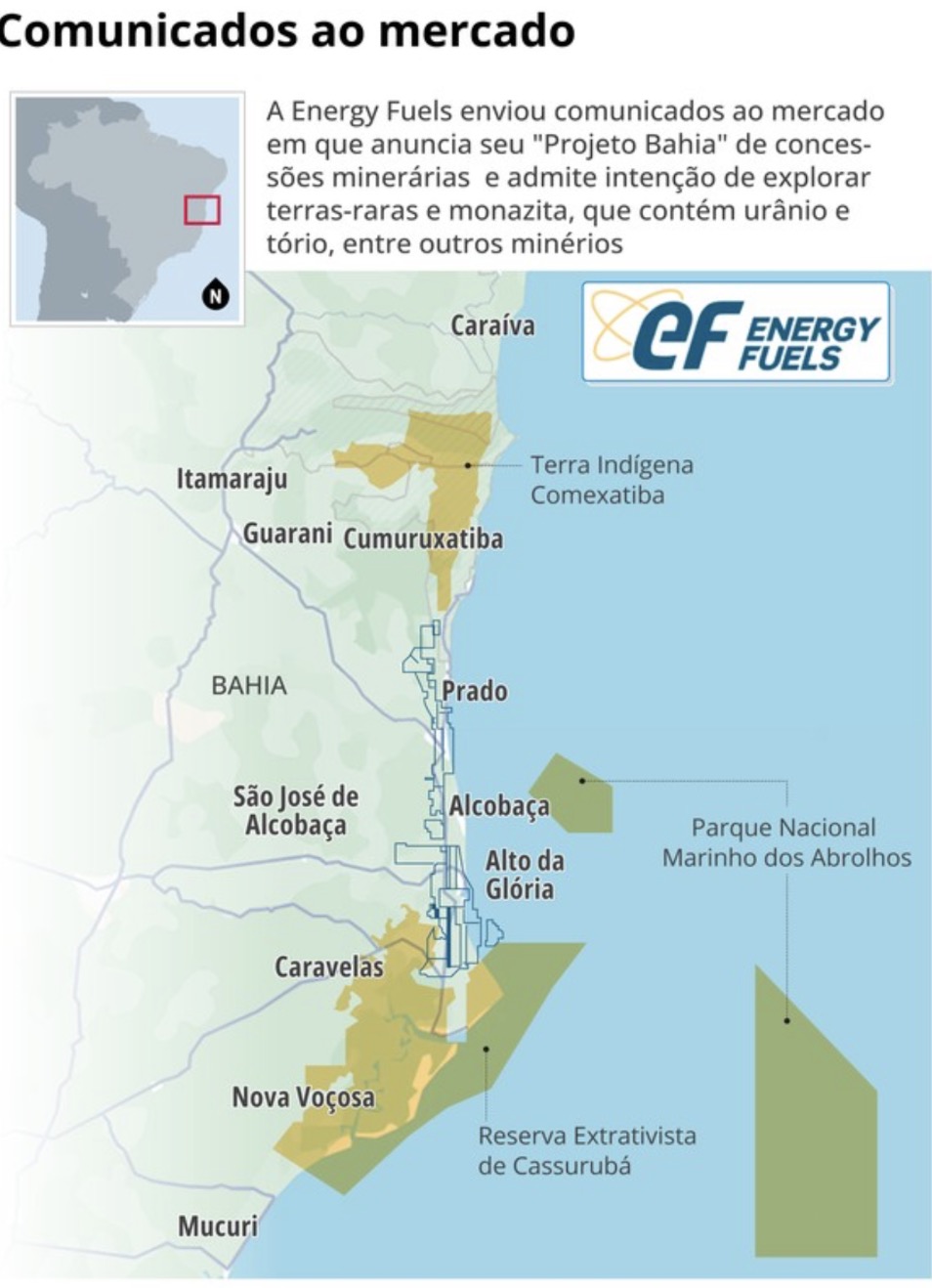
The newspaper reported that the Center for Nature Studies and Conservation (Cecna) had referred concerns to federal prosecutors. The proceeding was closed in September, while the project was still in a preliminary stage, without ruling out further action if irregularities subsequently emerged.
According to the same report, Bahia’s environmental agency Inema said it had authorized mineral research but had not issued a preliminary permit for commercial rare-earth extraction from the sand. Energy Fuels told the newspaper it would conduct the necessary environmental studies and comply with the law. These descriptions reflect the project’s reported status on October 10, 2026. Permission to investigate a deposit is not equivalent to commercial mining approval.
The region contains protected areas. Brazil’s biodiversity agency ICMBio identifies the Cassurubá Extractive Reserve as a marine and coastal conservation unit. Its presence in the wider region does not, by itself, prove that the project’s boundaries overlap it. That determination requires precise geographic analysis.
The Bahia Project therefore needs to be assessed through mineral and environmental studies, clarification of the commodities to be exploited and the approvals required for each activity. Only that evidence can establish the project’s viability and its actual contribution to the rare-earth technology chain.
Brazil’s raw-material opportunity and the industrial question
The Bahia Project is better described, based on the sources reviewed, as a potential supplier of raw material than as an established downstream manufacturing operation. Energy Fuels still faces project-development, licensing and permitting steps, while questions remain about the substances listed in mining filings and potential environmental effects on the southern Bahia coast.
National legislation provides an industrial policy framework, but the law and the actual results of investment must be tracked separately.
Exporting monazite or concentrates could give Brazil a place in global supply chains. It does not guarantee that chemical separation, rare-earth metal and alloy production or magnet factories will be located in Brazil. Those decisions depend on technology, investment, contracts and the environmental requirements of each activity.
The most useful way to assess the project is to follow its expected output, the destination of the material, the environmental terms of any authorized operation and the industrial stages taking place in each country. These indicators distinguish mineral potential, actual production and Brazilian participation in technology manufacturing.
Read also: Brazil’s rare-earth reserves and limited output and the new Brazilian mineral policy.
This English report is based on public documents from Energy Fuels, technical and institutional sources, and the Brazilian reporting by Lucas Altino published in O Globo on October 10, 2026. The references to local mining-rights records, permits and community questions are attributed to that investigation. Corporate announcements are treated as the company’s own plans and estimates.