

NEODY MANIFESTO
Rare earths, artificial intelligence and the next frontier of Brazilian competitiveness
Brazil holds strategic resources. The question is how much knowledge it will build on top of them.
The country holds one of the largest known reserves of rare earths in the world while artificial intelligence, data and automation change how companies compete. Between the resource and development lies a decisive variable: knowledge capable of turning matter, information and technology into value.
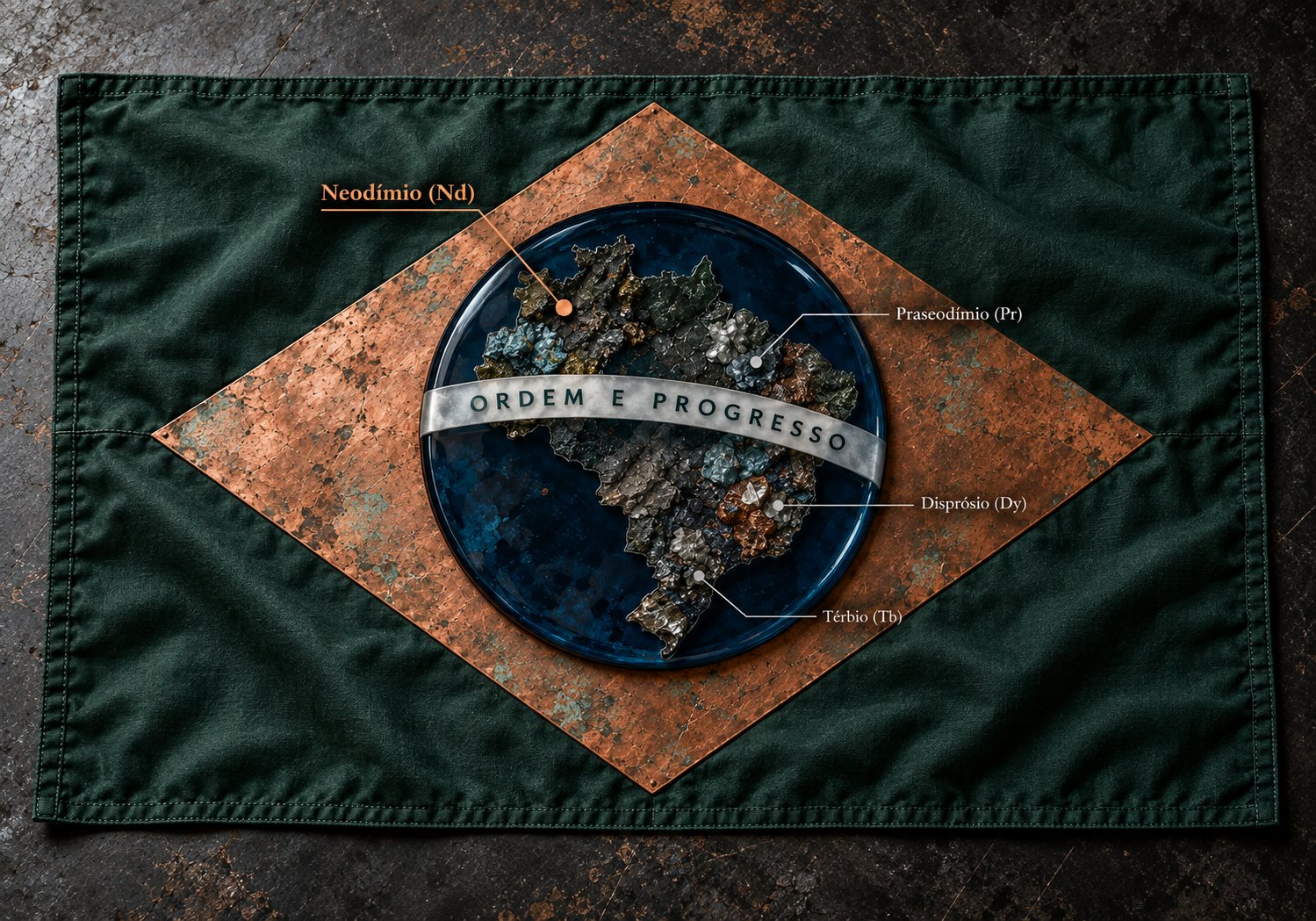
There are moments when a technological transformation seems distant until it quietly begins to change companies, markets and production chains.
The internet drastically reduced the cost of distributing information. Digitization changed financial services, retail and communication. E-commerce altered the relationship between location, inventory, convenience and access to the consumer.
Now artificial intelligence once again expands what companies can research, analyze, automate and produce. For Brazil, this transformation happens at the same time as another discussion gains economic weight: critical minerals and rare earths.
The country stands on both sides of this story. It holds strategic mineral resources, a large economy, industry, universities, research centers, entrepreneurs and professionals capable of producing knowledge. And it has millions of companies trying to understand increasingly complex markets.
The central question is not only what Brazil has. It is how much knowledge it will be able to add to what it has.
Brazil is among the largest holders of rare-earth reserves
The Mineral Commodity Summaries 2026 of the U.S. Geological Survey estimates Brazil's rare-earth reserves at approximately 21 million tonnes of rare-earth oxide equivalent. China appears with 44 million. Among the countries with quantified national reserves in the USGS table, Brazil ranks second.
Production tells another story. For 2025, the USGS estimated Brazilian production of about 2,000 tonnes, against 270,000 tonnes in China and estimated world production of 390,000 tonnes. Reserves and production measure different things, but the distance shows that geological availability does not automatically become industrial capability.
Mining is only the beginning of the chain. Between a deposit and a technology component lie beneficiation, chemical processing, element separation, refining, metal and alloy production, magnetic powders and magnet manufacturing. The International Energy Agency describes this sequence as a technically demanding chain in which different stages add value.
Where does Brazil stand in the industrial chain today?
Brazil already has rare-earth mining in Goiás and a federal policy that prioritizes the sector, but it does not yet have, at commercial scale, the complete chain of separation, refining, alloys and magnet manufacturing. NEODY has a dedicated report on each stage:
- Mining and concentrate: official production recorded by the National Mining Agency (ANM) is far smaller than the size of the reserves suggests. USGS and ANM figures use different measures, and the comparison is in Why does Brazil have so many rare earths but produce so little?
- Public policy: Law No. 15,506/2026 created the National Policy on Critical and Strategic Minerals. See what the new law changes for investors.
- Industrialization: at COP31 the government announced its intention to prioritize processing in the country. The question, according to the report, is who will make the magnets.
- Market and contracts: Serra Verde's agreement in Goiás with US buyers is covered in Brazil's Serra Verde starts rare-earth sales to a US buyer.
To follow all of the coverage, visit the NEODY rare-earths atlas and the Where Brazil can gain from AI series.
01 / RESOURCES AND KNOWLEDGE
The matter is the beginning.
Explore each section to follow how a resource becomes value.
01 / Value chainValue also lies in what happens after extraction
Mining is the beginning. Refining, engineering and manufacturing determine how much value a resource can create.
Open this reading
Value also lies in what happens after extraction
Mining is the beginning. Refining, engineering and manufacturing determine how much value a resource can create.
Value also lies in what happens after extraction
In 2024, according to the IEA, China accounted for roughly 60% of global mining of the rare earths used in magnets. Its share reached 91% in refining and about 94% in the production of sintered permanent magnets. These percentages refer to different stages and universes of the chain.
Having access to the raw material is not the same as controlling its value chain. Chemical knowledge, engineering, processing, industrial scale, machinery, professional training, research and intellectual property also determine the ability to turn a resource into a competitive product.
In September 2026, Law No. 15,506 created Brazil's National Policy on Critical and Strategic Minerals and the National Council for the Industrialization of Critical and Strategic Minerals. The law brings research, beneficiation, mineral transformation and value addition into Brazil's institutional agenda. The economic result will depend on factors that go well beyond the existence of reserves.
02 / Visual guide17 terras raras / 4 em focoFour elements help explain why
Two central functions in the magnet chain. A value that goes beyond the material.
NdNeodymiumPrPraseodymiumHigh performance
DyDysprosiumTbTerbiumAt high temperatures
The mineral matters.
So does the transformation.
Explore the four elements
Four elements help explain why
Two central functions in the magnet chain. A value that goes beyond the material.
High performance
At high temperatures
The mineral matters.
So does the transformation.
Four elements help explain why
Four elements. Two central functions.
Tap a symbol to understand its role.
ROLE IN THE CHAIN
Neodymium Nd
Central role in high-performance magnets.
Part of the permanent magnet chain, in which composition, processing and application determine performance.
ROLE IN THE CHAIN
Praseodymium Pr
Central role in high-performance magnets.
Tracked by the IEA alongside neodymium in its analysis of the rare earths used in magnets.
ROLE IN THE CHAIN
Dysprosium Dy
Can help preserve magnetic properties at high temperatures.
Its use depends on the application and the magnet composition. The four elements are not necessarily present in every magnet.
ROLE IN THE CHAIN
Terbium Tb
Can help preserve magnetic properties at high temperatures.
Its use depends on the application and the magnet composition. The four elements are not necessarily present in every magnet.
WHERE THIS CHAIN APPEARS
- Electric vehicle motors
- Wind turbines
- Industrial motors
- Data centers
- Some defense systems
Uses vary with the equipment and the material composition.
There are 17 elements classified as rare earths. For the high-performance permanent magnet chain, four deserve special attention: neodymium, praseodymium, dysprosium and terbium. The IEA tracks precisely these four elements when analyzing the rare earths used in magnets.
Neodymium and praseodymium play a central role in high-performance magnets; dysprosium and terbium can help preserve magnetic properties at high temperatures. Magnets from this chain appear in electric vehicle motors, wind turbines, industrial motors, data centers and some defense systems.
A small quantity of material can take part in products of enormous economic value. The mineral matters. The economic system includes everything that happens after it.

neodymium
The name NEODY came from this matter.
Neodymium offers a particularly fitting metaphor for the discussion we intend to build. A resource can remain in the ground, be extracted, concentrated, separated and refined. It can become part of an alloy, a high-performance magnet and, finally, a motor, industrial equipment or technology infrastructure.
Value changes as knowledge, technology and productive capacity are added. This logic goes beyond mining. It applies to data, artificial intelligence, companies and countries.
02 / INFORMATION AND CAPABILITY
Knowledge changes the scale.
Five perspectives on intelligence, companies and the Brazilian opportunity. Open a card to read.
03 / Market intelligenceIntelligence that once required far larger structures is beginning to change scale
Data, analysis and AI are making capabilities once reserved for large organizations more accessible.
Open this reading
Intelligence that once required far larger structures is beginning to change scale
Data, analysis and AI are making capabilities once reserved for large organizations more accessible.
Intelligence that once required far larger structures is beginning to change scale
For decades, sophisticated market intelligence was far more accessible to organizations able to fund specialized departments, proprietary research, large databases, consultancies and analytical tools. A large company could investigate regions, monitor competitors, study behavior, project demand and cross-reference vast amounts of information. For a small business, many of these capabilities were prohibitively expensive.
That imbalance has not disappeared, but it has begun to shrink. Public data is more accessible; computing infrastructure can be rented as a service; analytical tools have become cheaper. Artificial intelligence models can search, organize, compare and interpret volumes of information that previously required far more human time.
The ICT Enterprises 2025 survey, released by Cetic.br in 2026, found the use of artificial intelligence technologies in 17% of the companies in the surveyed population, up from 13% the year before. Among companies with 10 to 49 employees, the indicator rose from 10% to 15%. Among organizations with 250 or more employees, it reached 50%. A total of 4,174 companies were interviewed; the survey covers Brazilian companies with more than ten employees.
The gap between company sizes remains large. But a structural change is under way.
04 / Context and decisionBusiness owners can begin to observe a market they once saw only in part
Sales tell one part of the story. Demand, competition, territory and margin widen the view.
Open this reading
Business owners can begin to observe a market they once saw only in part
Sales tell one part of the story. Demand, competition, territory and margin widen the view.
Business owners can begin to observe a market they once saw only in part
In consulting work carried out by NEODY on projects within the Sebrae ecosystem, we have observed a pattern. We meet business owners with deep knowledge of their products, operations and customers, but with far less developed structures for systematically observing the market around them.
This observation is not a statistically representative survey of Brazilian small businesses. It is a field finding that deserves broader investigation. But the questions it raises are relevant.
A company can know exactly how much it sold yesterday and not know the size of the demand available around it. It can know which customers bought and not know why others stopped buying. It can track its own price and not understand the price structure of the market.
It can notice falling foot traffic in a shopping district without being able to separate the effects of new retail hubs, e-commerce, urban mobility, income, safety, demographic change and consumer behavior. It can celebrate rising revenue while margin, acquisition cost or dependence on a single channel erode the economic quality of that growth. This is where market intelligence becomes relevant.
05 / Small businessesA small business does not have to stay small in information
Structuring information helps investigate markets, compare alternatives and decide with more discernment.
Open this reading
A small business does not have to stay small in information
Structuring information helps investigate markets, compare alternatives and decide with more discernment.
A small business does not have to stay small in information
A regional manufacturer can study which municipalities hold the greatest distribution potential. A retailer can assess search demand, competition, reputation and behavior before choosing a new location. A distributor can compare territories and identify underserved areas. A B2B company can map potential customers before expanding its sales team. A manufacturer can track the prices, digital presence and positioning of competitors.
None of these analyses removes uncertainty or guarantees a correct decision. Structured information can, however, improve the question, reveal alternatives and reduce decisions made on perception alone.
A smaller company will always have less capital than a large corporation. It does not necessarily have to remain so limited in its ability to observe the market.
06 / Literacy and capabilityArtificial intelligence literacy is much more than learning a tool
There is a difference between using technology and building technological capability
Understanding limits, verifying data and connecting technology to strategy is how capability is built.
Open this reading
Artificial intelligence literacy is much more than learning a tool
There is a difference between using technology and building technological capability
Understanding limits, verifying data and connecting technology to strategy is how capability is built.
Artificial intelligence literacy is much more than learning a tool
There is a risk of reducing the discussion about artificial intelligence to a collection of prompts, apps and automations. Technological literacy requires understanding what the technology can do, where it fails, how to verify information, which data can be used and which should not be shared.
It requires deciding when to automate and when to keep human intervention; how to measure productivity; how to tell an impressive demonstration from an economically useful application. And, above all, how to connect technology to a business decision.
An organization that masters an app does not necessarily master artificial intelligence. Likewise, an organization with thousands of data points does not necessarily have market intelligence. Value appears when there is a method for turning information into understanding and understanding into action.
There is a difference between using technology and building technological capability
An economy can hold a mineral resource and depend on other countries to turn it into sophisticated components. It can also use advanced digital tools and remain dependent on infrastructure, knowledge and technologies developed elsewhere.
These scenarios do not mean that every technology should be produced domestically. Modern supply chains are international; cooperation, trade, capital and specialization are part of them. The strategic question is: at which stages does a company, an industry or an economy intend to build its own capability?
07 / Transformation and opportunityProsperity will not come from a prompt
The Brazilian opportunity lies in transformation
Prosperity depends on knowledge, strategy and execution. The opportunity lies in what we manage to transform.
Open this reading
Prosperity will not come from a prompt
The Brazilian opportunity lies in transformation
Prosperity depends on knowledge, strategy and execution. The opportunity lies in what we manage to transform.
Prosperity will not come from a prompt
New technologies generate enthusiasm and exaggeration. Artificial intelligence will create companies, products, professions and markets. It will also produce bad projects, waste, mistaken expectations and investments made out of fear of being left behind.
For that reason, NEODY does not start from the premise that technology produces prosperity automatically. Companies still depend on market, margin, capital, people, strategy, execution, learning, discipline and resilience. AI profoundly changes some of the capabilities available, but it does not eliminate business fundamentals.
The Brazilian opportunity lies in transformation
Brazil holds approximately 21 million tonnes of rare-earth reserves, as estimated by the USGS. It has a new national policy for critical and strategic minerals. It has companies beginning to expand their use of artificial intelligence. And it has a business base in which information, technology and analytical capacity can change decisions in thousands of local markets and production chains.
None of this determines the outcome in advance. But it reveals the scale of the opportunity. There is wealth below the surface, information available and new tools to understand it. The challenge is to build the capability that lies between the two.
The next leap comes after access
Access to the mineral, to data or to artificial intelligence is the beginning. What follows are the capabilities that turn those resources into results.
In the mineral universe: extraction → separation → refining → material → component → product.
In the business universe: data → context → analysis → decision → execution → learning.
There is a common logic between these chains: the greater the ability to transform a resource, the greater the chance of capturing value from it. This is where the meaning of NEODY (neodymium) meets our editorial mission.
The resource may be in the ground. The data may be available. The advantage begins when there is knowledge to transform them.
- From mineral to material.
- From data to decision.
- From research to technology.
- From intelligence to execution.
- From raw material to value.
Brazil does not need only to extract the future.
It needs to be able to develop it.
NEODY. neodymium
Business intelligence.
ESSENTIAL QUESTIONS
Rare earths, AI and business decisions
Does Brazil have the second-largest rare-earth reserves in the world?
In the table of quantified national reserves in the Mineral Commodity Summaries 2026, the USGS estimates 21 million tonnes for Brazil, behind China at 44 million tonnes. Estimated reserves do not mean production or refining capacity.
Which rare earths matter for permanent magnets?
The International Energy Agency mainly tracks neodymium, praseodymium, dysprosium and terbium in the high-performance permanent magnet chain. Their importance depends on the application and the composition of the magnet.
What is neodymium used for?
Neodymium is part of NdFeB permanent magnets used in motors, generators and other equipment. Between the ore and the final component come separation, refining, metal and alloy production and industrial manufacturing.
What is the link between rare earths and artificial intelligence?
The link is strategic, not a technical equivalence: minerals and materials can be part of technology infrastructure, while AI expands analysis and decision-making capabilities. In both cases, the value depends on the knowledge applied after access to the resource.
How can a small business use AI strategically?
It can start with one concrete decision, define the right indicator, check the data and its limits, test a small application and measure the result. Automating an activity without understanding the problem can amplify errors.
Sources and method
Reserve and production data refer to USGS estimates for 2025, published in 2026. Shares in the magnet chain refer to 2024 and to specific universes described by the IEA. NEODY's field experience is qualitative and should not be extrapolated to all Brazilian companies.
- USGS, Mineral Commodity Summaries 2026: Rare Earths
- IEA, Rare Earth Elements: Executive Summary
- Cetic.br, ICT Enterprises 2025
- Law No. 15,506 of September 16, 2026 (Brazil, Portuguese)
This is the English edition of the NEODY manifesto, published on November 21, 2026. The Portuguese original was published on September 30, 2026.


01 / The matter
neodymium

02 / NEODY
NEODY

03 / The transformation